Costs
Fixed wireless: questions about the unit, path and hub
Fixed wireless buyers can assess the rooftop unit, radio path and provider hub by asking about ownership, weather, capacity, installation and contract remedies.
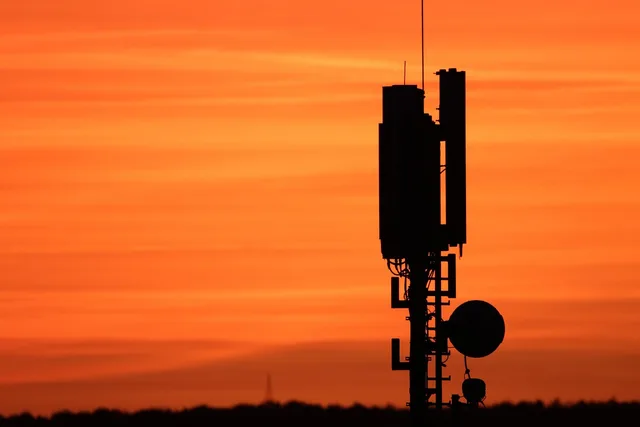
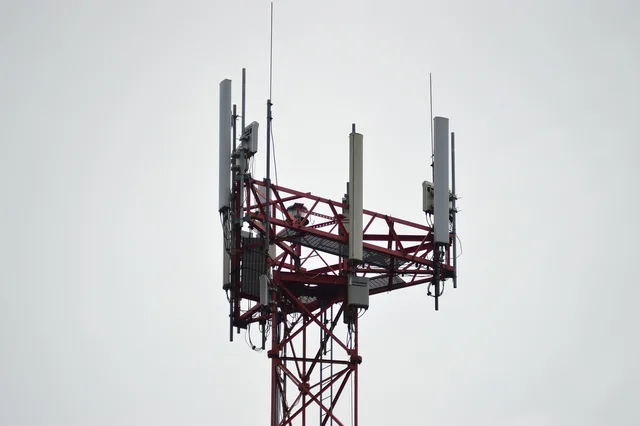
A fixed wireless service is three things bolted together: a dish or panel on your building, a stretch of air, and a hub the provider owns somewhere with a clear view of you. Understand the three pieces separately and most questions about the service answer themselves: each fails in its own way and each is somebody's responsibility.
It gets confused with cellular because both are radio. They are different products. A cellular service gives you a share of a public cell that thousands of handsets also use. A fixed wireless link is engineered for your building: an antenna aimed at a specific point, on a path the provider has surveyed, with capacity the provider has planned for.
What to take away
- The link is engineered, not ambient. That is why it can be far more predictable than cellular, and why it needs a survey and an installer.
- Ask about the hub end as hard as you ask about your own end. Its power, its backhaul and how many others hang off it decide your busy-hour experience.
- Treat installation as a small building project with a landlord in it, not as a delivery.
Piece one: the equipment on your building
An outdoor unit, mounted where it can see the hub, connects to the building by a cable carrying data and usually power.
Inside, a small box converts that into an ordinary network port for your router.
Questions that belong to this piece:
Equipment on your building
- Who owns the outdoor unit during the term and at the end of it, and who takes it down?
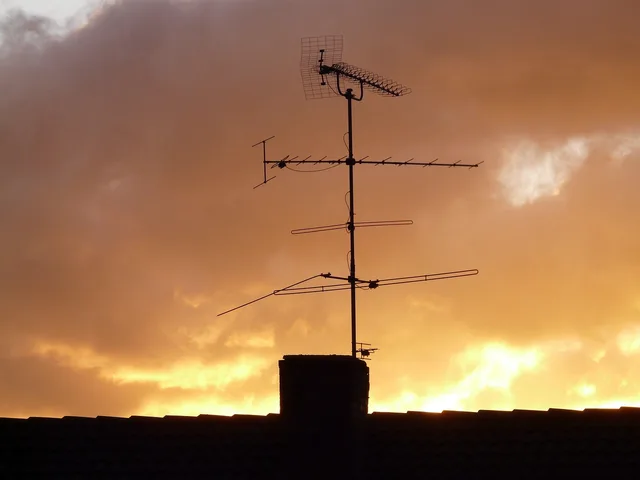
- Where exactly does it go? A roof, a wall, a pole, a mast on a chimney? Each has its own consent and access story.
- How is it powered, and from which socket? If that socket is on the same circuit as the kettle, somebody will eventually find out.
- Who is responsible if it is damaged by weather, roof works or a contractor who did not know it was there?
Piece two: the air
The path between your unit and the hub must stay clear for the life of the
contract, and the world does not promise that. The provider will survey it before install. What they cannot survey is next year.
Ask what happens when the path degrades: a new building, a tree in full leaf, scaffolding on your own frontage. Specifically: who diagnoses it, who pays for a visit to re-aim or relocate the unit, and whether the contract lets you leave if the path cannot be restored. A provider who has thought about this will have a plain answer. One who has not will say it never happens.
Preparedness guidance on severe weather is a fair reminder that the path is outdoors and the weather is not a rare event.
Ask also how the link behaves in heavy rain and fog. Some radio bands are barely affected and some are affected a lot. The provider knows which they use.
Before any of that, turn your own activities into a target rather than accepting a headline figure: the FCC's broadband speed guide is a plain way to do it.
Piece three: the hub, and what feeds it
This is the piece people forget, and the one that decides whether the service feels like a dedicated circuit or a busy cafe.
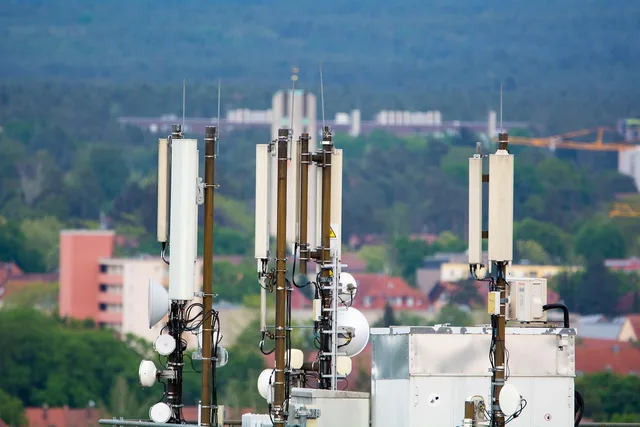
The hub is a site the provider controls: a tall building, a mast, a water tower. Your link lands there. From there, your traffic has to get to the rest of the internet, over a fiber or another radio hop, and that onward link has a capacity that is shared by every customer on the hub.
A shared link can affect delay and loss, just as capacity and congestion matter for any business internet connection.
So ask:
The hub and what feeds it
- How is the hub connected onward, and is that link a fiber or another radio hop? A chain of radio hops multiplies the weather and path risks.
- How many customers share it, roughly, and how is capacity managed at the busy hour?
- How is the hub powered, and does it have battery or generator backup? Your own battery unit is pointless if the hub goes dark in the same cut.
- Is your link one of many pointed at a shared sector, or a dedicated point-to-point link with its own capacity? These are different products at different prices and it should be plain which you are being sold.
Installation is a building project
Fast compared with a trench, slow compared with a parcel. The steps that eat time are almost never technical:
- Landlord consent for something on the roof or wall. Get this moving on day one; it is the usual reason a short install becomes a long one.
- Roof access, and whether working at height needs specific arrangements.
- The cable route into the building, through what, and who makes good.
- Power at the point of entry.
- The survey itself, which may fail, in which case you want to know early.
Ask the provider for lead time with and without consent in hand. Montgomery County, Maryland, says antenna and wireless permits for commercial buildings are typically issued within three to four weeks from submittal, depending on staff workload and timing of the Transmission Facilities Coordination Group meeting.
The gap is your risk.
Where it belongs
Fixed wireless is a strong first choice when a wired build is slow, blocked by land you do not control, or priced beyond reason, and when the site has a clear view of somewhere the provider already serves. It is a strong second choice for almost any business whose wired connection matters enough that a single dig could hurt, because a radio path and a buried cable fail for different reasons.
It is a weaker choice where nobody has checked the path, where the hub is a mystery, or where you are being asked to commit to a long term with no protection against the path changing.
When you are choosing between radio options, the split is simple. If you need something today with no installation, that is 5G business internet. If you need something engineered for the building that can be relied on at the busy hour, that is this.
Before you sign
- Get the survey result in writing, including the headroom on the link.
- Get the shared-or-dedicated answer in writing.
- Get the path-degradation process in writingwho, who pays, and your exit.
- Confirm equipment ownership and removal at the end.
- Confirm what the fault process is and what the remedy is when it is missed.
- If a phone system will run over the link, confirm what your battery unit covers and what it does not, and confirm how the provider routes 911 calls. The FCC's E911 rules (47 CFR Part 9) require interconnected VoIP services to support 911 and to give you a way to keep your registered address current, and that only works if you do.
What changes over the life of the contract
A radio path is the only part of a connection a third party can degrade without touching your building. Three things do it, and all three are foreseeable:
What changes over the contract
- Growth.A tree that clears the path in March can obstruct it in July, and it will be taller next year. Ask who inspects and who pays.
- Building.Scaffolding on your own frontage is the version people forget, because it is temporary and still six weeks of poor service.
- Load.The sector fills as the provider sells. Nothing changes at your end, and the busy hour gets worse.
The contract question that follows is short: if the path can no longer carry what was sold, what happens? A remedy, a relocation, or a release. A provider who will write one of those three into the agreement is offering something the others are not, and it costs nothing to ask.
Common questions
Is it as reliable as a wired connection?
A well-engineered link with headroom, a clear path and a properly fed hub can be extremely reliable. A link installed at the edge of its range, on a busy sector, behind a radio chain, is not. The variation between installations is much larger than between wired services, which is why the questions above matter more here.
Does the dish need a permit?
In the US, the FCC's OTARD rule (47 CFR 1.4000) protects your right to install certain antennas — fixed wireless units included — on space you exclusively control, such as a balcony, a patio or a yard only you can use. It does not give you the roof of a shared building, so your landlord's consent still governs there, and local zoning and permitting can still apply. Your installer should tell you what applies; if they cannot, ask your city or county zoning office before anything is bolted on.
Can the same provider give me a wired service too?
Sometimes, and it can be convenient. For resilience, though, the point is that the two services should not share a hub, a cable or a network. Ask directly, because a single supplier will not always volunteer that their two products land in the same place.
How long does it take to get working?
Quickly where consent is not an issue and the survey passes. Longer where a landlord has to approve something. Faster than a fiber internet build to an unserved building in almost every case.
In this guide
- Fixed wireless setup: survey, mount, ground, testA fixed wireless setup is decided outdoors: survey the sight line, mount for stability, route and ground the cable, then test the link for a week.
- Fixed wireless sign-up checks: 5 items, 4 sector questionsFixed wireless sign-up checks: survey, install, equipment, recurring charge and site visits, four mast-sector questions, and who owns the antenna.
- Inside fixed wireless alternatives: reaching a building no cable servesFixed wireless alternatives exist for the same problem it solves: reaching a building no cable serves. Compare them by independence, latency and what weather does.
- Fixed wireless trials: what to log for two weeks and how to read itA two week fixed wireless trial, not someone else's review: what to measure hourly and per minute, and what each pattern in your log means for the link.
- Comparing the main routes for fixed wireless on where they genuinely differFixed wireless routes compared by band, sharing and path: point-to-point, point-to-multipoint, unlicensed 60 GHz and 5 GHz, and licensed links.